Showing posts with label Anchorage. Show all posts

Tuesday, August 23, 2011

Back in the air - IFR to Homer

Day 12: Seward to Anchorage to Homer

It rained all night. By morning we discovered a bit of a leak in the tent rain fly, and the and foot box of sleeping bags a bit wet - luckily the down inside still dry.. need to fix that fly. The plan was to get rid of the rental car and resume travel in the airplane... the weather was supposed to clear out today. Supposed to!

We quickly tore down camp, ate breakfast in the nice large rain shelter, and hit the the road to try to return rental car at the main Anchorage (Ted Stevens International) airport by noon. I'd rented the car there despite leaving the airplane parked at Merrill field to save money ($40/day rental vs. $150...). A slight logistical pain, but now I had an excuse to fly from Merrill into Lake Hood (or Anchorage International), so I didn't mind. We got back to Merrill field around 1130, where I loaded the airplane as my wife drove the rental car back.

It was apparent the weather wasn't clearing out as quickly as forecast - it was supposed to be nice by now. Instead a cold front form a weakening low was slowly meandering north, now just past Homer. Anchorage had a ceiling around 900' broken with overcast just above. The weather was clearing from the south with our destination, Homer, reporting 2000' overcast. Another excellent briefing from the Kenai FSS suggested that even low-level VFR wouldn't work out as an area between Kenai and Homer tended to have very low ceilings in this circumstance. This leg, however, was one of the few where I could fly IFR without worrying about icing due to the lower terrain and minimum altitudes along the route.

The next step was getting from Merrill to Anchorage International. Geeky as it is, I thought it would be fun to land at Lake Hood strip, and then depart from Anchorage International. The two are joined by a taxiway that crosses a road.

At Merrill, I requested a special VFR clearance to get over to Lake Hood Strip. Many other operators were also requesting SVFR to get out of town. It was a good 10-minute delay waiting for IFR arrivals before the tower could launch departures, and the ensuing antics were amusing... a Cessna 180 requested SVFR just after me, and soon he asked that he'd be a flight of two with his buddy if that would speed things up. A couple of minutes later, another pilot called in and asked if they could be a flight of three... some impromptu formation flying briefings were happening, I'm sure. The controllers, however, did not mind and I'm assuming they all went on their merry way. Welcome to flying in Alaska!

The flight to Lake Hood was perhaps the shortest I've ever done. Its all of 4 miles. Takeoff, "cruise" at 800' for all of 30 seconds, with a little turn to give a tall building and radio antenna some room, and then you're on base to the Lake Hood Strip, swooping in low over Lake Hood before turning a nice, tight, half-mile final.

The controllers gave me helpful directions to taxi across several roads -- some with pilot-operated gates (click the mic on a certain frequency to open them), and then across something of a railroad crossing triggered by taxiing your airplane close to the road, with the arms that go down and everything. Again, very geeky to be excited about that, but I'll bet you would be too when you saw it for the first time. I taxied over to a GA parking area that I'd previously scoped out on the international airport side, reachable for a pedestrian - maybe 200 yards from the car rental area, which worked out well for our purposes. By the time all that was done, I'd "flown" 0.4 loggable hours for a 2-and-a-half minute flight.

After picking up my wife, and IFR clearance, we went through another taxi-gate to the "big" ramp with B747 freighters parked left and right, presumably exchanging their goods, or just stopping for fuel between their exotic ports of call in Asia and elsewhere in North America.

Lets review that depature one last time!

The flight to Homer was straightforward if lacking a nice view - we climbed into the clouds at 1,000', getting a bit of a break between layers once but otherwise just plain gray, sometimes rainy sky, though it was pleasantly smooth, cruising at 6,000'.

Sometime after passing Kenai, another aircraft from Anchorage passed me by somewhere in the gray ether, a Piper Navajo I think. A Mooney passed by a Navajo: sad, right? Well I was flying slow to save gas! ATC asked me to slow to minimum speed. I'd soon figure out why: Their radar coverage went down to 5,000' or so by Homer, so it was one airplane at a time on the approach. I slowed down to maybe a hundred knots, loafing along thinking I'd get my approach clearance soon enough. Then, 20 miles from Homer a "lifeguard" (air ambulance) flight checked on, also going to Homer.... there was no question there -- they have priority over me. Just as I thought I might have to hold, I was given holding instructions.

"Mooney five one mike, hold as published at the Homer VOR, expect further clearance at 2150, time now 2130".

Here I am, instrument rated for 11 years, practicing holds every 6 months as a currency requirement, and I get my first real hold, ever. I wasn't going to complain, I would have had to practice a hold next month to keep my currency once again anyway. After this excitement quickly wore off I realized there was no hold published at the Homer VOR, at least on any of the charts I had. Some back and forth with the controller produced a bizarrely-worded clearance that would make me actually think about the proper hold entry (parallel, thanks for asking).

As I finished the entry, the lifeguard flight landed and I was given approach clearance -- a DME arc to a localizer back-course. The winds were slack, but this was a few less miles to fly than the front course. More good practice, right? I flew a decent enough approach and broke out at 2,000' or so.

Back on the ground, we walked to downtown Homer, about 2.5 miles. At first I have to admit based on that walk of shoulder-less road, wondering if this town was worth the stop. Those feelings were quickly admonished when we came across an Eagles' nest near the center of town. A pair of Bald Eagles had raised two offspring there over the spring and they were the stars of town, as you couldn't miss them. A couple of friendly passerby's gave us the story: The two babies were now adolescents, nearly grown. One had flown by itself already and was off somewhere else. Both parents were sitting in a tree a hundred yards or so from the nest waiting for the other baby to fly. It would take a few test hops - getting maybe a foot or so off of a branch next to the nest, but wouldn't yet commit to flight. Apparently this had been the scene for some days, and people were wondering if the remaining Eagle would take flight, or eventually be abandoned as the parents moved on. A nearby marine life visitor center was another interesting diversion.

Adolescent Bald Eagle, Homer
Turning to lodging, we had a recommendation for an outfit that rented cabins but didn't receive a call-back. Homer, however, is full of B&Bs and a few minutes of walking and looking later we had a wonderful place not far from the ocean, perched over an art gallery.. my wife was pleased! The gallery and three-room B&B were owned by a very talented local artist, who from the appearance of things was also a successful entrepreneur. A rare(?) combination.

Homer seaplane lake
An Australian couple, retired, traveling with their mid 20s daughter occupied in room next door. They know how to travel and are enjoying retirement: Airline Melbourne to Seattle, the marine highway into Alaska, to King Salmon (according to them, a dissapointment), Homer, a week exploring the Kenai Peninsula to Anchorage, then across Canada and eventually home after visiting New York & the U.S. east coast in a month.

Fire Hydrant art, Homer
We took a walking tour of Homer and settled on a nice local pub for a most excellent burger & a brew for dinner. Between the local characters and art scene it was easy to see how Jewel got her start here.It was apparent between accomodation and dining that we had just missed the tourist wave.. life was quiet here, and presumably would be much more so once winter started to set in.

After dinner, a brief foray to the beach, where locals drive their trucks down to enjoy evening bonfires. Still plenty of light at 10pm, and the weather had finally cleared to the south and west allowing for a nice sunset, and interesting view of the volcanoes of Augustine Island and Mt. Iliamna poking up above the horizon on the opposite side of the Cook Inlet. The tide goes up and down over 30 feet here at its extreme. Amazing.

Tomorrow, Seldovia.


Saturday, August 20, 2011

On the ground in Anchorage


Day 9: Anchorage.

I took a few days off of flying to explore Anchorage and its surroundings until my wife flew up on an airline from California. Executive summary for someone considering visiting Anchorage: The city offers surprisingly decent deals on food, fuel, and equipment considering its location. For the pilot or aviation enthusiast, taking some time to explore the local flying scene, Lake Hood, and the aviation museum are worthwhile diversions. Other than these, I offer one simple recommendation: Get out of town. A friend of mine in California remarked before I left that Anchorage reminded him a lot of a larger version Klamath Falls, Oregon where we went to college: a functional if somewhat depressed ex-logging town surrounded by good outdoor opportunities. I think his assessment was spot on.

My choice for lodging was a hostel. This started out good and turned out bad, but then they are often a crap-shoot. The place was clean though, and surprisingly was frequented by an older set of travelers, something I wasn't used to. My prior hosteling experiences have been in Europe where it was mainly the college and early-20s set. Here the owner enforced no drinking & smoking rules, and reasonable quiet hours. The nice thing is that you usually meet one or more interesting people, and this was no exception.

My sole roomate was Ira, a 76-year old semi-retired nightclub owner from Missouri. He had travelled to Alaska on a ferry, up on the Alaska marine highway, camping out along with the younger folks to save money and enjoy the view. His businesses had done well and were now mostly managed by his children, but he still preferred to use budget accomodations travelling for the same reasons I did: to meet people and be able to afford longer trips.

"If I'm not going for 5-6 weeks, I may as well stay home" he remarked. I want to have that attitude to travel when I'm 76, and beyond.

Ira had some interesting tales to tell about the Blues club business. From being backstage with Elvis before he was big, to big-name blues musicians [the name alludes me and my notes] who showed up at his club unannounced, after bailing out of a big-dollar gig at a large auditorium after playing just an hour-long set, to then play at his place until the sun rose. He'd led an interesting life, now spending his summers at a cabin in the high mountains of New Mexico where he had some interesting tales on the ramifications of befriending a black bear.

I did a walking tour of downtown Anchorage, but didn't feel compelled to check much out. Perhaps if I were in the market for something made of fur, or a bearskin rug? Later I caught a bus over to the main airport (Ted Stevens) where I'd secured a cheap rental car (the standard rate was well over $130 a day -- get a corporate discount code if you can), and to check out neighboring Lake Hood.

Lake Hood is a must-do for folks with any interest in aviation, and will probably be interesting even for those who aren't into airplanes. A large lake, adjacent Ted Stevens international airport is home to a towered seaplane base with several runways (water lanes), a gravel strip, and like Merrill Field, hundreds of aircraft jammed into every nook and cranny. The difference here was that many were floatplanes with a "slip" rented as you would a tie down. On the far side of the field a float dealer had row upon row of aircraft floats stacked on racks. Every parking spot was occupied. Specially modified trucks were set up to take non-amphibious airplanes out of the water. Roads doubled as taxiways with signs warning motorists to yield to airplanes, and pilot-operated gates allowed aircraft to cross from the gravel runway at Lake Hood Strip, over a series of road/taxiways, and into the international airport. The whole place was abuzz with activity.

B737 gravel deflector
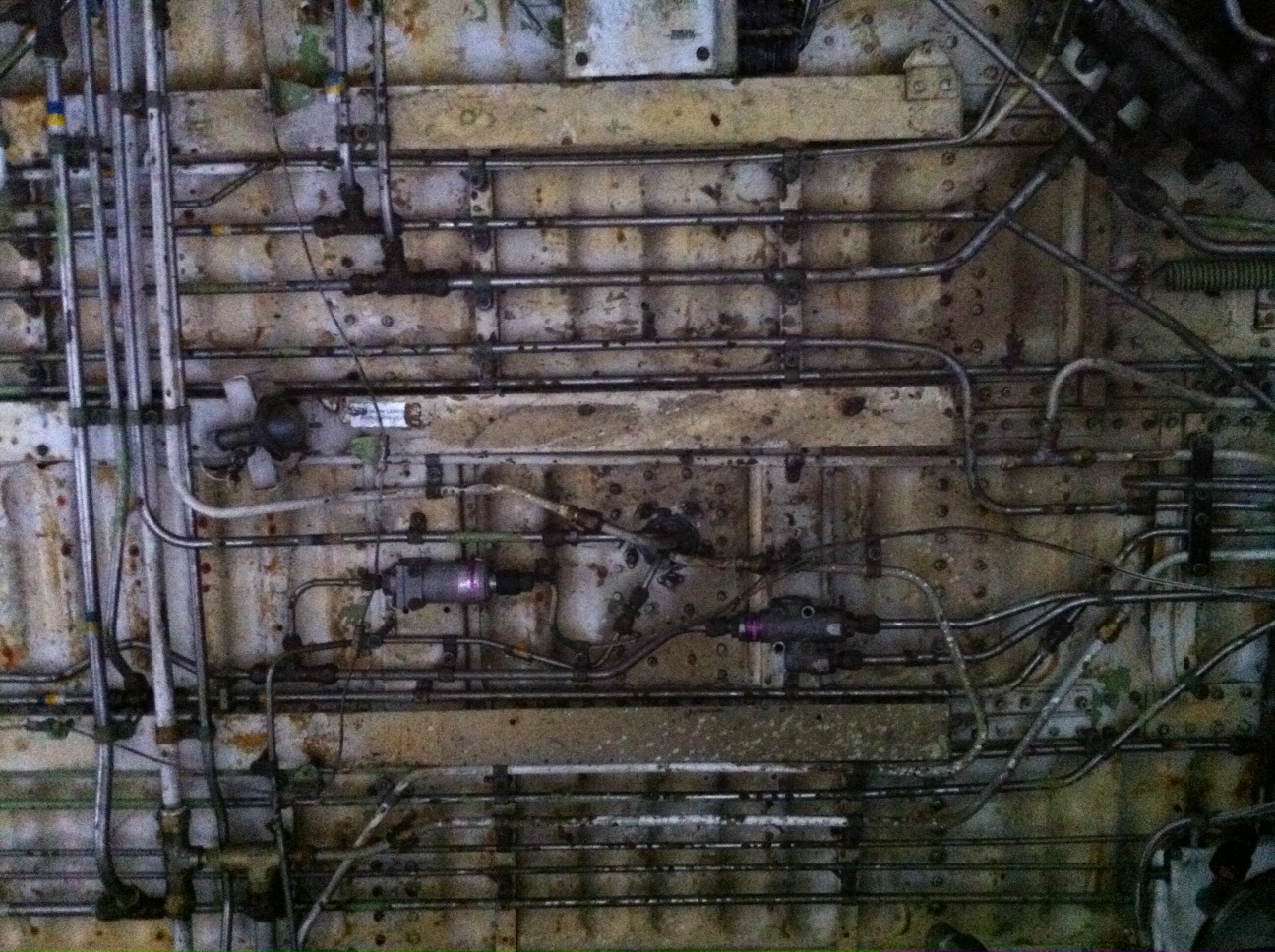
The Alaska Aviation Heritage Museum, also at Lake Hood, chronicles the progression of aviation in the state from bush pilots to the progression of Alaska Airlines. The museum I'd rank as interesting but "OK"... something you can skip if budgeting time (but don't skip a trip around Lake Hood!). The most interesting thing, to me, was a retired Alaska B737-200 with a gravel kit installed, out in the open for visitors to poke around. The aircraft had something like 67,000 flight hours on it before being retired, and had many areas of damage that were repaired (i.e. dings near boarding doors that were fixed with fat doublers and massive quantities of rivets). This made me feel better about my airplane with 4,300+ hours since new.

Into the Matrix?

B737 skin doublers

B737 engine modification to deflect air at the ground to prevent injestion of rocks and debris

Besides Lake Hood, I poked around the area and found the nearby Earthquake Park and was surprised by how lush the coastal forest was; there were a plethora of colorful mushrooms.

Beyond that, the road wrapped around the back side of the international airport offering a nice place, surprisingly close to the runway, to watch airliners and B747 freighters land. It was refreshing to see someone taking their kid down to watch airplanes land, rather than an environment of paranoia that might cause such an act to be treated suspiciously in a place like, say, New York.

Friday, August 19, 2011

Mooney fun in Talkeetna, introduction to Anchorage

Day 8: Palmer to Anchorage (Merrill field), Alaska

I was put in contact with a local Mooney owner by one of the Mooney parts suppliers I use in California. The owner, an A&P mechanic who had done an outstanding job restoring his M20C, and his lovely family made arrangements to meet me in Wasilla for fuel before flying our respective airplanes up to Talkeetna for lunch. As usual, the weather was interesting. The wind at Palmer and Talkeetna, dead calm. Wasilla, barely a 5-minute flight to the west of Palmer in similar geography, had wind gusting to well over 20 knots. Between Wasilla and Talkeetna, low fog (which we'd fly over), all underneath an altostratus deck that kept the Alaska range hidden from view.

Wasilla to Talkeetna, flight of two
The 5-minute hop over to Wasilla was uneventful aside from spotting numorous airstrips. Everyone and their uncle flies here, and being a well-populated area the land was littered with grass runways galore. One could take a quick look around from 1,500' AGL and probably count 20 unpaved runways within a few mile radius. The family I was meeting based their airplanes off of such a (shared) private strip. At Wasilla, we did a quick briefing to fly formation to Talkeetna; I'd be wing-man of course. The wind was gone within a few minutes of departing Wasilla and it was a surprisingly smooth flight. My host flew a good, solid, stable lead and it required very little effort to hold formation along the way.

Along the way my hosts were kind enough to get some nice air-to-air photos of me, and I managed to get a quick camera phone video in while at a safe distance.


Turbine DeHavilland Otter
Talkeetna is worth a stop on any Alaskan trip. Several air taxi services operate tour and other charter flights to circle around nearby Denali, the highest peak in North America. Many of the flights include glacier landings, a technique pioneered by bush pilot legend Don Sheldon. Some go to see the sights, others to start climbs. A couple friends of ours made attempts on Denali (one with a successful summit) several years ago, and launched each expedition to the mountain with a flight out of Talkeetna  All manner of bushplanes from Cessna 180s to Beavers and turbine-powered DeHavilland Otters were fitted with retractable skis for this purpose. The air tour activity, even on a cloudy day, runs nearly non-stop. Seeing a turbine Otter (think small school-bus on wings with a thousand-horsepower turbine on the front end) nearly levitate off the end of the runway was impressive every time.
DeHavilland Beaver

The town itself is all of a few square blocks, pretty all over, and while a tourist trap, was my kind of tourist trap: Few  kitchy wares for sale, but plenty of good food and, for those done wit their flying for the day, great beer that I'd get to try on my next visit (I decided right then and there to bring my wife back later).

My hosts treated me to a great Reindeer sausage sandwich for lunch before we walked back to the airport to go our separate ways.

On my own once again I looked over the Anchorage terminal chart and Alaska Flight Supplement to brief a flight into Merrill Field, one of Anchorage's airports. My wife was still 48 hours from arriving so I'd reserved a rental car and cheap place to stay for a couple of nights. I'd previously read that flying into the Anchorage area is akin to a bee returning to the swarm around a nest. Anchorage itself is a medium-sized city, but has a collection of airports smashed up against each other, from an air force base to a large international airport and worldwide cargo hub. Because of all this the airspace to get in and out of various airports is stratified.

One example of this is going into Merrill from the northwest as I was planning to do. I'd cross into town from the west over the Knik arm of the Cook Inlet. The special flight rules in the area specify that a pilot going into Merrill cross the arm, and then downtown, at either under 600', or above 2,000' -- fighter and heavy transport traffic to and from the air force base flies between.. and that was one little slice of airspace, among many in the area. En route, I was in an area with actual radar coverage for the first time since leaving Seattle, and got traffic advisories. No longer was the reply light on the transponder dark, as it had been for the last week of flying.

Once handed over to Merrill tower crossing the Knik arm, I finally saw why things were divvied up this way - the air force base was right next door. I was instructed to fly north of the field on downwind to land to the west, and made a pretty tight traffic pattern (even by my own standards) to do so. One thing I noticed flying almost every day for the past week was that my skills had ratcheted up considerably. I fly the Mooney, on average, once a week but this much time between man and machine tends to step things up a bit, and make the airplane an extension of the pilot. Being on one's "A" game to maneuver the airplane to a precise location, speed, and altitude were that much easier.

I landed in the rain, and even so it didn't take long for my appreciation of Merrill to develop. Here was an area, several city blocks' in size, completely littered with airplanes and related businesses over every square foot. General aviation is on a slow decline in the lower 48, here it is thriving, if out of nothing else than necessity. The airport was abuzz with Super Cubs launching for remote locales, Cessna 207s hauling cargo, and even King Airs with cargo pods on their bellies. One thing absent was a big fancy FBO (fixed base operator) ready to roll out the red carpet for a customer. Here it was all function over form. For a pilot, it was an exciting place to be.